What makes a great course welcome email? | Email Breakdown with Lucy Werner
There’s something fascinating about breaking down a really good email.
Not the flashy, over-designed ones packed with countdown timers and “BUY NOW” buttons. But the thoughtful emails that quietly do their job brilliantly.
In a recent conversation for my Email Breakdown series, I sat down with PR expert and creator of Hype Yourself, Lucy Werner, to analyse a course welcome email from newsletter strategist Dan Oshinsky. And the deeper we got into it, the more clever it became…
At first glance, the email looks incredibly simple. But underneath that simplicity is a masterclass in onboarding, expectation-setting, and building trust with readers.
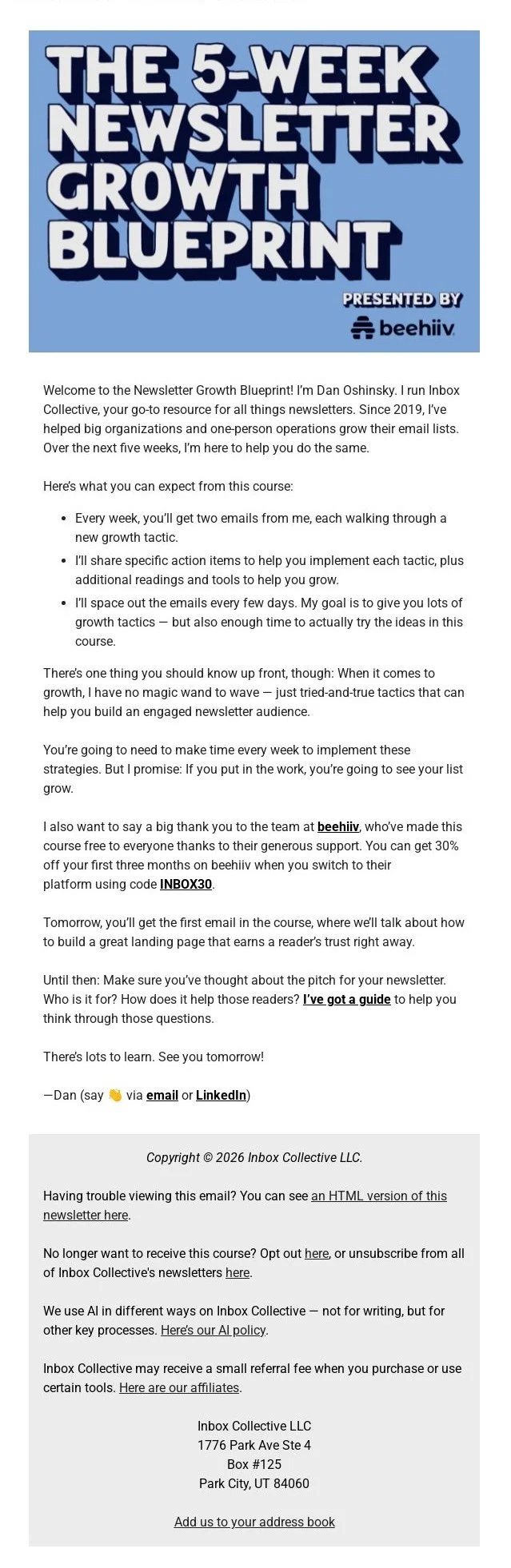
Here are some of the biggest lessons Lucy and I pulled from it.
The “Free Email Course” is more powerful than a PDF
Lucy explained that she originally signed up for Dan’s newsletter growth blueprint because it was delivered as a short email course rather than a downloadable freebie.
And I completely agreed with her.
For years, creators have relied on PDFs and downloadable guides as lead magnets. But the reality is most people never actually open them, let alone finish reading them.
An email course feels lighter and easier to commit to. The content arrives gradually, directly in your inbox, without creating another thing to save “for later.”
As Lucy put it:
“I’m not a big video person, I’m not a big live call person, so getting emails in my inbox in a short email-course way really appealed to me.”
There’s also something very clever and very meta about teaching newsletter growth through newsletters themselves!
Repetition helps readers recognise you
One thing Lucy pointed out early on was how every email in the sequence used the same bold banner image and the same “5-Week Newsletter Growth Blueprint” branding.
A lot of us worry about repeating ourselves visually in email marketing. We think every email needs a completely fresh design.
But actually, repetition helps readers instantly recognise your emails in a busy inbox.
Lucy said:
“We’re scared of repeating ourselves. But it helped differentiate what was coming into my inbox.”
That consistency becomes part of the experience.
And interestingly, the header itself was huge. Far larger than most ecommerce-style email advice would recommend.
Normally, I’m thinking:
get the headline up top
get the CTA visible immediately
optimise for clicks
But this email wasn’t trying to hard-sell anything. The goal was onboarding and trust-building, so the oversized visual actually worked.
Credibility doesn’t need to be loud
One of our favourite parts of the email was how quickly Dan established authority without sounding overwhelming or salesy.
Lucy broke this down brilliantly using the A-B-C-D framework she teaches:
Attention
Benefits
Credentials
Direction
Instead of listing endless achievements or audience numbers, he kept it incredibly simple:
who he helps
what he does
how long he’s done it
who he’s worked with
That’s it.
Lucy summed it up perfectly:
“He gives the credentials without veering into bro-marketing land.”
No “7-figure newsletter growth.”
No massive vanity metrics.
No impossible promises.
That restraint makes the expertise feel even more trustworthy.
Great welcome emails reduce anxiety
The more we discussed the email, the more we realised how much of it was designed to make the reader feel safe.
The email clearly explains:
what’s coming
how often emails will arrive
what readers will need to do
how long the course lasts
One tiny detail I loved was where Dan explained that the emails would be spaced out over several days.
That immediately softens the commitment.
Lucy connected this to workshop facilitation and how people naturally feel calmer when they know what to expect:
“The brain actually feels really comfortable when we know what’s coming.”
Sometimes onboarding isn’t about excitement. It’s about reducing uncertainty.
“No magic wand” marketing feels refreshing
One section we both loved was where Dan openly says there’s “no magic wand.”
Again, it’s the complete opposite of the aggressive growth-marketing language we see everywhere online.
Rather than pretending newsletter growth is instant or effortless, he’s upfront that readers will need to implement the strategies themselves.
Lucy made a really good point here:
“You’re not gonna be able to just read this and then magically grow. You actually are gonna have to do it.”
That honesty actually works in his favour because it attracts people who are ready to take action. And gently filters out people looking for shortcuts.
Personality matters more than ever
Towards the end of our conversation, we started talking more broadly about newsletters, branding, and AI-generated content.
Lucy says something I quote all the time now:
“Show a little bit of ankle.”
Meaning: don’t overshare your entire life online, but do let people see enough of you to connect with you as a human.
Lucy talked about how mentioning her move to France actually created more opportunities and deeper audience connection - even though she originally worried it would alienate her UK audience.
It’s such an important reminder in a world where so much content is starting to sound the same.
You don’t need to tell people everything. But you do need to sound like a real person.
Your emails can be shorter than you think
One final thing we both noticed: the emails themselves were actually quite short.
Instead of cramming every possible detail into the inbox, Dan regularly linked out to longer resources and deeper blog posts.
Lucy said something that I think most of us probably need reminding of:
“We can make our emails shorter.”
Your newsletter doesn’t have to carry the full weight of your expertise every single time. Sometimes its job is simply to guide people toward the next step.
The bigger lesson
What I loved most about this email wasn’t necessarily the design or even the strategy behind it.
It was the tone.
It felt calm.
Clear.
Practical.
Confident without trying too hard.
And increasingly, that kind of communication stands out.
Like learning from someone who genuinely knows what they’re talking about.
Want your own (private!) email review? I can SHOW you what works, what doesn’t, and how you can make sure YOUR emails convert. I teardown your emails, so that you can build them up bigger and better - CLICK HERE!