The Anatomy of a High-Converting Email | Email Breakdown with Laura Burton
If you’ve ever wondered what actually makes someone open an email… click… and buy…
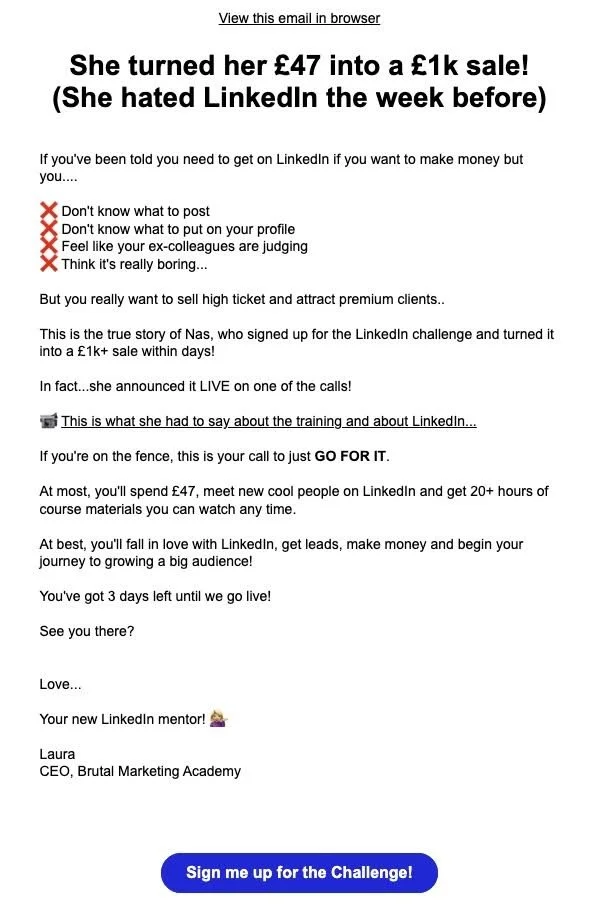
In this breakdown, I sat down with marketing mentor Laura Burton to go through an email she sent as part of a paid challenge launch.
One that got a 79.22% open rate and a solid click-through rate to match.
Let’s get into what made it work (and what you can steal)…
Specificity wins every time
The subject line?
“She got a 21% ROI”
Simple. Clear. Specific.
And that specificity is doing a lot of heavy lifting. Instead of something vague like “you need to see this”, it gives a concrete result. It feels real. Believable. And most importantly, it sparks curiosity without being clickbait.
There’s something about oddly specific details that builds trust instantly. It signals that this is a real story, not a fluffy promise.
If your subject lines feel a bit generic, this is the first place to look.
Make it scannable
One of the smartest things in this email is the structure. It opens with quick, relatable pain points. Short lines. Easy to scan. You can glance at it and immediately decide:
“Is this for me?”
And that’s exactly the point. Some people will read every word, but many won’t.
So the job of your email isn’t to force attention, it’s to earn it quickly. Clean formatting, short sections, and even small visual cues (like emojis used intentionally) all help guide the reader.
You can lead with pain, but don’t stay there
This email does start with pain points:
You don’t want to post
You’re not seeing results
You’re stuck
But it doesn’t linger there. Instead, it quickly pivots into possibility.
And this is important.
There’s a lot of copywriting advice that says you need to “agitate the pain” to sell. But in reality, people don’t want to sit in that feeling for long.
What worked here is the balance: Pain → Recognition → Solution → Hope
You’re acknowledging the struggle, not dwelling in it.
Use case studies (but don’t overload them)
The email brings in a short, punchy case study that ties back to the subject line. This works because readers can see themselves in the story.
That’s what testimonials really do. They help someone think:
“Okay… if it worked for them, maybe it could work for me too.”
But there’s a limit. Too many testimonials, or overly long ones, can feel overwhelming. (Or as Laura put it, a bit exhausting.) The key is using them strategically. One strong, relevant example will always beat five mediocre ones.
Reframe the “worst case scenario”
This was one of my favourite details. Instead of saying:
“At least you’ll get this…”
Laura’s email says:
“At most, you’ll spend £47….”
“At best, you’ll fall in love with LinkedIn and start getting leads”
It’s subtle, but powerful. You’re still addressing the risk, but you’re framing both outcomes positively.
No one is being reminded of what they might lose. Instead, they’re shown what they’ll gain, either way.
Personal brand matters more than you think
This is the part people often overlook. This email didn’t perform well just because of the copy.
It performed well because of everything around it.
The audience already knew, liked, and trusted the sender. They were used to hearing from her. They’d seen her content. They’d engaged before. So when the email landed, it wasn’t coming from a stranger. It was coming from someone they already had a connection with.
Your emails don’t exist in isolation. They’re part of your wider brand.
Segmentation isn’t optional
Another big driver behind the performance? Segmentation.
Not just by interests, but by engagement.
People who hadn’t opened in months were treated differently
Highly engaged subscribers were prioritised
Click behaviour influenced follow-up emails
This meant the right people were seeing the right messages at the right time. And it also prevented list fatigue, which is where a lot of campaigns fall flat.
If there’s one takeaway from this email, it’s this: performance isn’t about one clever trick. It’s the layering. Specificity in the subject line, clarity in the structure, emotional pacing in the body, and smart segmentation working quietly in the background.
Want your own (private!) email review? I can SHOW you what works, what doesn’t, and how you can make sure YOUR emails convert. I teardown your emails, so that you can build them up bigger and better - CLICK HERE!